Public speaking consistently ranks as one of the most common fears people report. More feared than spiders, heights, or flying. That statistic gets cited constantly, usually followed by reassurance that "you're not alone," which is true but not particularly useful when you're standing in front of thirty people with a dry mouth and a racing heart.
The more useful truth is this: the fear of public speaking is not a fixed trait. It's a learned response, and like most learned responses, it can be unlearned. Not eliminated, exactly, but trained down to a level where it stops running the show.
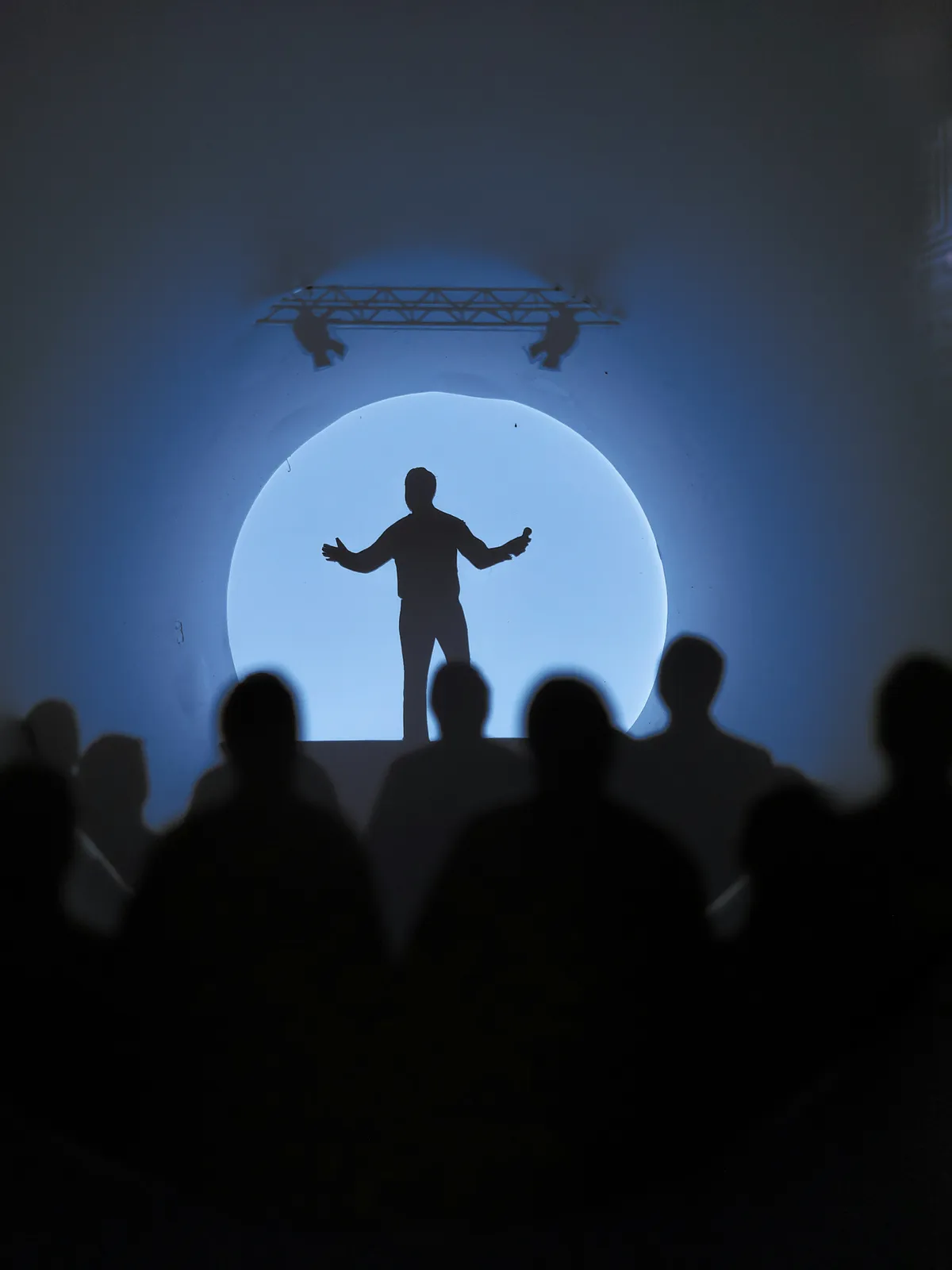
What's Actually Happening When You Freeze
The physical symptoms of public speaking anxiety (shaking voice, racing heart, blank mind, sweaty palms) are identical to a general stress response. Your body reads "audience watching me" as threat, floods you with adrenaline, and routes blood to your muscles in case you need to run.
This is not irrational. For most of human history, being watched and evaluated by a group carried real social stakes. The anxiety isn't a malfunction. It's an ancient system running in the wrong context.
The problem is that most public speaking advice tries to argue with the anxiety ("just remember they want you to succeed!") or suppress it ("breathe deeply and you'll calm down"). Neither works reliably, because the anxiety is operating below the level of conscious thought. You can't logic your way out of an adrenaline response.
What actually works is systematic exposure. You get comfortable in front of audiences by being in front of audiences, repeatedly, in controlled, low-stakes ways. The nervous system updates its threat model based on evidence, not reassurance.
Why Most Advice Misses
Visualization doesn't transfer
Athletes visualize performance successfully because they've already logged thousands of real repetitions. The visualization fills in gaps on a well-worn neural path. For speakers who haven't logged those repetitions, visualization builds a fantasy of success that has no connection to how the actual experience feels. The body doesn't know what standing in front of people feels like, so it can't simulate it accurately.
Memorizing more makes it worse
The instinct is to prepare so thoroughly that nothing can go wrong. The result is a speaker whose confidence is entirely dependent on the script. The moment anything deviates from the memorized version (a lost word, an unexpected question, a distraction), the whole structure collapses. Over-scripting creates fragility, not confidence.
Relaxation techniques help, but not much
Deep breathing, progressive muscle relaxation, and power poses reduce baseline anxiety marginally. They're worth having as tools. But they don't change the underlying threat model, and they don't build the experience that actually matters. A speaker who breathes deeply before a talk is still a speaker who has never gotten comfortable being watched.
What Actually Helps
Reps in low-stakes environments
The fastest path to comfort in front of audiences is to be in front of audiences, a lot, in situations where the consequences of a bad performance are low. This could mean joining a speaking group, doing open mics, volunteering to present at team meetings, or playing structured speaking games.
PowerPoint Karaoke is a particularly efficient version of this. Each round puts you in front of a group, speaking without preparation, with no option to bail out mid-slide. The stakes are low (it's a game) but the physical experience is real. After ten rounds, your nervous system has evidence that being in front of a room is survivable. That evidence is what changes the response.
Embrace the discomfort instead of fighting it
Research on anxiety reappraisal suggests that telling yourself "I'm excited" rather than "I'm nervous" is more effective than trying to calm down. Excitement and anxiety produce identical physical sensations. The only difference is the story you attach to them. Trying to eliminate the adrenaline works against you; channeling it changes what it does.
Experienced speakers often describe a state where pre-talk nerves feel like energy rather than fear. That's not because they've eliminated the anxiety. It's because they've accumulated enough positive experiences in front of rooms that the adrenaline now reads as "this is about to go well" rather than "this is dangerous."
Practice with imperfect conditions
Practicing your talk alone in a quiet room trains you for a condition that never actually exists. Practice in environments that are slightly chaotic: with a friend who asks random questions, with distractions in the background, in a different room than you planned. The goal is to train robustness, not polish. A speaker who can hold their thread when something unexpected happens is more confident than one who can only perform perfectly prepared remarks in ideal conditions.
Learn to stay in the stumble
The single most visible difference between a nervous speaker and a confident one is how they handle the moments where things go sideways. Nervous speakers treat a stumble as a catastrophe and either rush to cover it up or visibly panic. Confident speakers pause, find their footing, and continue. The stumble itself is rarely what the audience notices. The recovery is everything.
This is a learnable skill, but you can only learn it by stumbling and recovering, repeatedly, until the recovery becomes automatic. Games like PowerPoint Karaoke force dozens of small stumbles per round, each one followed by recovery. Over time, the recovery habit builds.
A Practical Starting Point
If you're working on building speaking confidence, a simple structure that works:
- Once a week, speak in a low-stakes group setting. A game night, a speaking club, a work meeting where you volunteer to present something short. The format matters less than the consistency.
- After each time, note one thing that went better than expected. This isn't positive thinking. It's building an accurate record that contradicts the fear response's predictions. The brain updates on evidence. Give it evidence.
- Increase stakes gradually. A game night leads to a team meeting. A team meeting leads to an all-hands. Each step is more comfortable because the previous ones have updated the threat model.
- Don't wait until you're "ready." The readiness comes from doing it, not from preparing to do it. There is no amount of preparation that produces the feeling of being ready. That feeling comes afterward.
The Honest Timeline
Fear of public speaking doesn't disappear after one good talk. It typically takes months of regular exposure before the baseline anxiety noticeably drops. Most people who describe themselves as "comfortable" public speakers still feel some nervousness before talks. The difference is that it no longer stops them, and it no longer ruins the performance.
That's the realistic goal: not fearlessness, but fear that doesn't interfere. A nervous system that's been trained to run "audience watching me" through a filter of accumulated good experiences rather than pure threat detection.
The mechanism is repetition. The fastest way to get repetitions is to find formats where repetitions are easy: games, groups, low-stakes contexts where you can rack up experiences quickly. That's the whole logic behind using PowerPoint Karaoke as a speaking training tool. Not because it's a presentation class, but because it makes repetitions fast, frequent, and surprisingly fun.
One round of PowerPoint Karaoke puts you in front of a room, speaking without notes, in about five minutes. That's a rep. Get a few in.
Play a Round Now →